Changing the Reglementen
The rules that govern the association are found in various different places. The law specifies some rules we (sadly) have to abide by and our statutes provide some more rules, but the vast majority of rules that dictate how the association functions are found in the reglementen. Currently we have three reglementen that contain a significant number of rules: one on alcohol, one on the building and one on the association. The last one, also known as the Huishoudelijk Reglement, was developed in 1994 and has since been incrementally changed from time to time until it became the frankensteined abomination it is today.
While the current Huishoudelijk Reglement is technically functional, many clauses are archaic and were build around an association and a society that functioned very differently than today. Communication to members is still written based on the idea that mail has to be delivered physically, workgroups have not functioned like described in HR for over a decade and while we’re technically still electing the members of committees, we’ve never quite followed those rules the way they were written. Lastly the current Huishoudelijk Reglement is not that well-organized: the vast majority of the rules is simply chucked under the article ‘structuur’, a lot of subarticles contain many run-on sentences that bunch together a lot of rules in unclear ways and quite a few sections are not that worked out for brevity’s sake.
Because of this, last year the HR-workgroup was created. We dug deep into our reglementen with the intent of presenting a new and improved version, which will be happening at the members assembly on the 7th of October. In this article I’m not going into the details of these changes, as that is better left to the members assembly itself, but I’m showing some of the behind the scenes with regard to the process of building the new reglementen.
When we started out we set the following goals for the new Huishoudelijk Reglement:
It should be written in simple language whenever possible;
It should contain no internal contradictions;
It should be as clear and concise as possible;
It should refer to other documents, such as the law, statutes or Alcoholbestuursreglement whenever relevant information is located there;
It should only contain clauses that are actionable, measurable and achievable as an association;
It should be complete;
It should not contain bloated information – such articles should be transformed into separate regulatory documents instead;
It should match what is actually happening in the Koornbeurs;
We started the process by taking a look at the things we really cannot change at this point in time: first of all we decided would be quite a bit too ambitious for us to change the law, so we quickly gave up on that idea and compiled a list of stuff the law requires our rules to have. Secondly changing our statuten right now would not be that convenient, so we decided to work within the confines they set as well. Lastly changing the Alcoholbestuursreglement requires the cooperation of the municipality, which is not at all guaranteed, thus it made more sense to not try and change any of those rules. This left us with a bunch of rules we needed to somehow stick to and a Huishoudelijk Reglement and Sociëteitsreglement that we could make changes to.
When studying the Huishoudelijk Reglement we quickly concluded there were a few sections that required much more thorough elaboration but would also become long and annoying to put into the body of the Huishoudelijk Reglement. We therefore decided that there should be separate reglementen for the organs of the association, the functioning of the membersassembly, sanctions and payment rules. Initially we also considered having separate reglementen for definitions, the board and financial powers as well, though later realized this was not as convenient for various reasons. Statuten provides a convenient definition for reglementen: they are documents that need either three quarters of the members to show up to an assembly or two members assemblies to change them. That’s actually quite nice: we don’t want to be able to change these reglementen on the fly. By creating different documents we can keep the Huishoudelijk Reglement concise and still elaborate thoroughly when necessary.
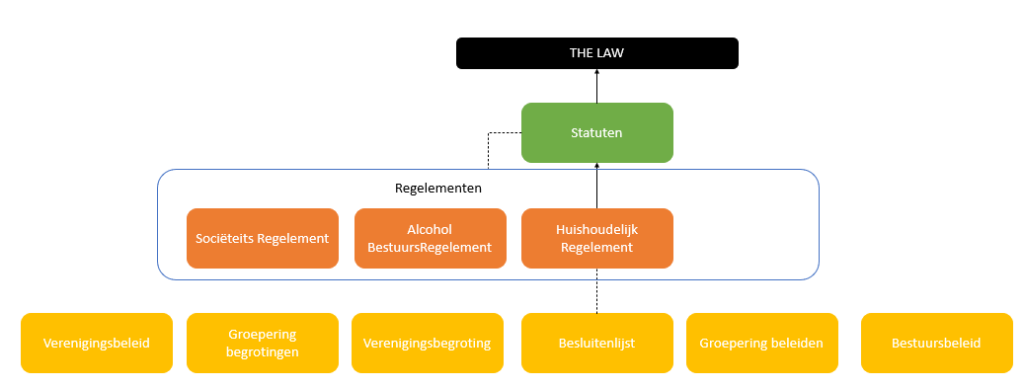
The current reglementen and the way they are connected:
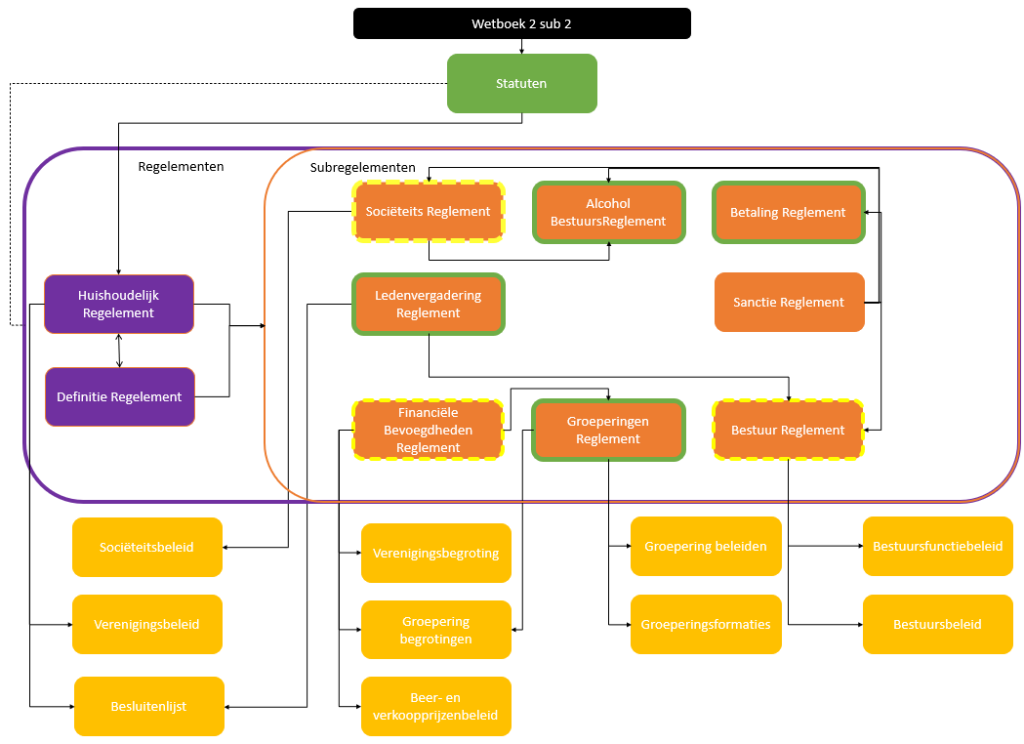
The first idea we had on changing it… oh how naïve we were at that point.
After setting out the basic structure we just started splitting up the old Huishoudelijk Reglement and rewriting sections. We stumbled upon a list of classifications that slowly became the backbone of the new Huishoudelijk Reglement: ‘plichten, taken, bevoegdheden, rechten’ or duties, tasks, powers and rights. It turns out that by specifying those four aspects for things like committees, members and the board paints quite a clear picture that is easily digestable. We defined these four as the following:
Plichten are responsibilities someone or something is charged with that have a minimum level of satisfaction that should be achieved;
Taken are goals someone or something is supposed to achieve;
Bevoegdheden are active powers that you are allowed to use;
Rechten are passive powers that someone or something always has;
A few examples are:
the plicht of the bookkeepers to maintain the financial administration;
the plicht of the members to pay contribution;
the taak of the/the/a Senate to maintain a long term vision for the association;
the taak of the board to govern the association;
the bevoegdheid of the Vertrouwenscontactpersonen to see confidential information
the bevoegheid of any organ to receive a proxy by the members assembly to represent the Koornbeurs in some capacity
the recht of members to receive ledenpost
the recht of members to enter the building
The second big change we propose is to move a substantial part of our rules to policies. Organs such as committees and the board could add further plichten, taken, bevoegdheden and rechten to their beleid that can be changed in a single members assembly and are more specific than the ones in the Huishoudelijk Reglement. Additionally sanctions such as alcohol bans and permissions such as being allowed to use powertools with permission from HenSkie and being allowed to cook mensa after having completed an inkook are also properly specified instead of just common knowledge. Important decisions that currently live somewhere in the depths of the besluitenlijst can also be moved into beleiden. This would require a large overhaul to the policies during the next WLV which we’d be preparing for after the new Huishoudelijk Reglement gets (hopefully) accepted.
The last big change we made is split up all of the paragraph long clauses into separate articles that state just one single thing clearly and removed much of the verbose jargon in favor of simple and consistent wording across all the reglementen. We’re very happy with the result of this and are personally convinced it makes the new Huishoudelijk Reglement significantly more legible. Since we additionally provided a large overhaul to the structure in order to group relevant rulings more closely together, the overall result is a much easier Huishoudelijk Reglement that doesn’t require the equivalence of three PhD’s to digest.
We encourage you to read through the new Huishoudelijk Reglement and see if there is anything you don’t understand: after months of working on it, we need some outside perspective to make sure all of it makes sense to all members.
If you would like to read the reglementen for yourself use the following link and log in with your koornbeurs account: https://nextcloud.koornbeurs.net/apps/files/files/1170887
Send Giovanni a message if you don’t know your koornbeurs account.